
Aaron's Gift
An Ember Day with George Herbert

“The chief article and foundation of the gospel is that before you take Christ as an example, you accept and recognize him as a gift, as a present that God has given you and that is your own” (Martin Luther, “A Brief Instruction on What to Look for and Expect in the Gospels”).
Wednesday, Friday, and Saturday of this week are the traditional spring Ember Days. Others occur in the weeks following Pentecost, Holy Cross Day, and St. Lucy’s Day. Ember Days originally had to do with the agricultural year, but in my church, as in some others, they are now associated with the ordained ministry. Postulants for diaconal and priestly ordination write to their bishops each Ember Week, updating their father or mother in God about their spiritual, vocational, and educational progress. They are a good chance for us all, lay or ordained, to reflect on the state of our vocations within the Body of Christ.
By a happy coincidence, today, Friday, February 27th, is also the Episcopal Church’s commemoration of George Herbert, “Priest and Poet” (BOS 117).
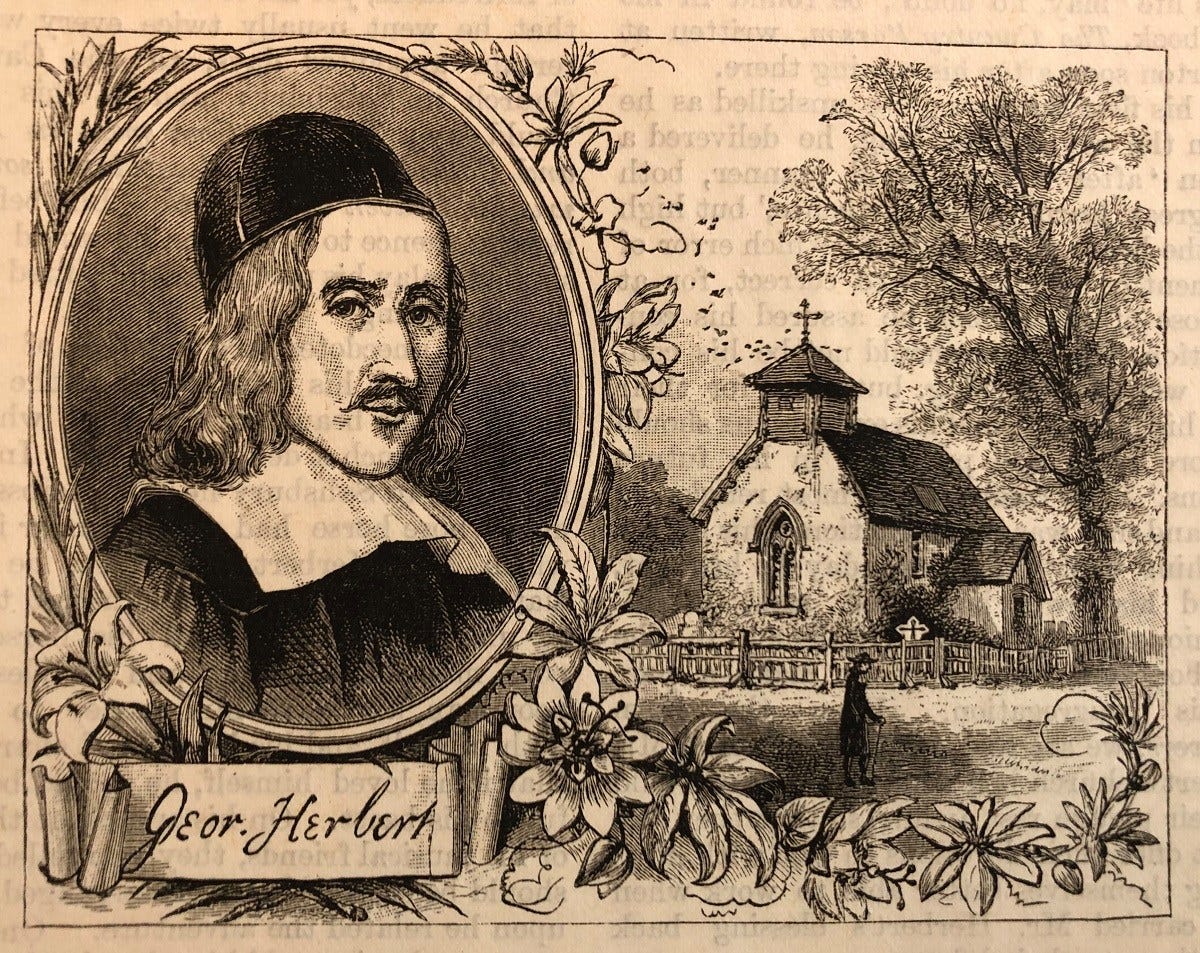
Here is his well-known poem “Aaron”:
                Holiness on the head,
         Light and perfections on the breast,
Harmonious bells below, raising the dead
         To lead them unto life and rest:
                Thus are true Aarons drest.

                Profaneness in my head,
         Defects and darkness in my breast,
A noise of passions ringing me for dead
         Unto a place where is no rest:
                Poor priest, thus am I drest.

                Only another head
         I have, another heart and breast,
Another music, making live, not dead,
         Without whom I could have no rest:
                In him I am well drest.

                Christ is my only head,
         My alone-only heart and breast,
My only music, striking me ev'n dead,
         That to the old man I may rest,
                And be in him new-drest.

                So, holy in my head,
         Perfect and light in my dear breast,
My doctrine tun'd by Christ (who is not dead,
         But lives in me while I do rest),
                Come people; Aaron's drest.
This poem is sometimes hung up in sacristies or clergy offices, because it seems to describe so well the symbolism of clerical dress. The name ‘Aaron,’ the brother of Moses and Israel’s first high priest, is used to stand in for ‘priest’ as Herbert contrasts his own unworthiness with the standard of righteousness the ministry deserves. The first stanza describes Aaron’s garments in Exodus 28, which, as the New Testament suggests, served as “a copy and shadow of the heavenly sanctuary” (Heb 8:5), with Jesus Christ as our eternal high priest. He is God’s holiness, he the divine Light who raises the dead, he the one “true Aaron,” the Mediator between God and mankind.
And surely, the one, heavenly priest is to be the example for the earthly priests who follow him and serve in his church. What the Lord did once for all, perfectly, and continues to do before the Father, the Christian priest ought to do imperfectly but faithfully: stand between heaven and Earth, announcing Good News from the Father and pleading for the people. (S)he is to “proclaim by word and deed the Gospel of Jesus Christ…to love and serve the people among whom [(s)he] work[s]…to preach, to declare God's forgiveness to penitent sinners, to pronounce God's blessing, to share in the administration of Holy Baptism and in the celebration of the mysteries of Christ's Body and Blood.” In short, (s)he is “to nourish Christ's people from the riches of his grace, and strengthen them to glorify God in this life and in the life to come” (BCP 531). This is what it means to be a priest.
And yet this glorious calling seems to cause George Herbert, an ordained minister in the Church of England, immense anxiety in stanza two. Compared with the Lord, who is he to call himself a priest? Who is he to do any of these things? He is profane, defective, overshadowed with passions and practically dead in his sin. If Jesus Christ is to be his example, he is a “poor priest” indeed.
But then the poem makes a great turn. This is how things would stand if Christ were primarily an example for his ministers to follow, primarily the one who shows us priests (or preachers, or pastors) how we ought to act in our service towards God and on behalf of his people. But that is not how things stand, because Christ is not primarily an example for us to imitate but a gift from his Father and ours, “a present that God has given us and that is [our] own,” as Luther put it.
Protestants are used to thinking about this in terms of justification, the ‘happy exchange’ whereby Christ gives the believer all that belongs to him, entirely free of charge and without conditions. This is how we are saved. We are clothed with Christ’s own righteousness; it is, in the theological idiom of classical Protestantism, ‘imputed’ to us as a sheer gift. It is not something we have earned, or even something we come to possess little by little, as we become more and more worthy of heaven. It is something which is always extra nos, literally ‘outside ourselves,’ in Christ and therefore impossible to lose, diminish, or doubt.
But this same logic underlies Herbert’s rather Catholicizing vision of priesthood. Christ is that “other head,” “another heart and breast” freely shared with the all-too-human Herbert. He is in Christ and Christ in him, and this fact — not anything about him, his moral or religious capabilities — means that he can perform the functions of a priest. It is not a question of his worthiness, any more than we need ask the bread whether it feels ‘worthy’ to convey the Lord’s body, or the water whether it feels ‘worthy’ to bring new, baptismal life. It is simply a matter of God’s decision, of his freely electing and equipping Herbert to do things utterly beyond his natural capabilities.
This doesn’t mean that Herbert ceases to be the flawed, sinful, imperfect man he is in himself. It is that man, the one so painfully conscious of his own shortcomings, who is “in Christ,” that man who is “tun’d by Christ” and made a fit instrument for the divine purpose. “I have been crucified with Christ; it is no longer I who live, but Christ who lives in me; and the life I now live in the flesh I live by faith in the Son of God, who loved me and gave himself for me” (Gal 2:20).
What I am trying to say is that the priestly vocation is not a law, not a burden of imitation which we could never come close to fulfilling. It is a gift; indeed, it is the one gift of Jesus Christ himself, viewed from the angle of ministry. Just as we freely receive his righteousness and so are justified, we receive his priestly vocation and so serve. He gives himself to us. When we act in a priestly way (celebrating the sacraments, pronouncing absolution, preaching, and so forth), we can do so confidently, because the grounds of what we do lies extra nos, outside of ourselves, in him. We truly become “little Christs” (to borrow from Luther once more), and this is the defining fact of our existence, not anything in ourselves. And this is true for all of us, for ordained, ministerial priests and for those who, through baptism, “share with us in [Christ’s] eternal priesthood” (BCP 308). There is no essential difference.
Almighty God, who didst call thy servant George Herbert from the pursuit of worldly honors to be a poet and a pastor of souls: Give us grace, we pray, joyfully to dedicate all our powers to thy service; through Jesus Christ our Lord, who liveth and reigneth with thee and the Holy Ghost, one God, for ever and ever. Amen.